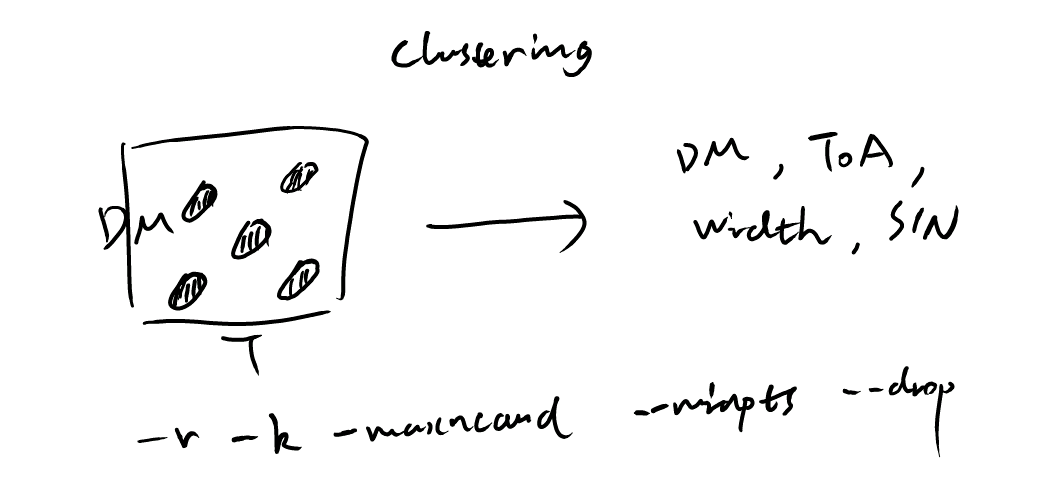
Clustering
The clustering step applies the DBSCAN algorithm (see Men and Barr (2024)) to group detected single pulse events into candidates based on their proximity in time and DM space. This helps reduce duplicate detections.
The options -r and -k set the parameters eps and min_samples of the DBSCAN algorithm, which control clustering sensitivity. A larger eps value allows more distant points to be considered part of the same cluster, while a larger min_samples value requires more points to form a cluster.
The option --maxncand limits the maximum number of candidates generated after clustering one data chunk. If the number of candidates exceeds this limit, only the top candidates with the highest S/N are kept for further processing.
The option --drop drops candidates whose boxcar width equals the maximum boxcar width used in matched filtering. These candidates are likely RFI, and dropping them helps reduce false positives.